Master the TOK Essay and Exhibition with an active IB examiner and bestselling TOK book author. Structured frameworks, real examiner insight, and proven strategies for top marks.
Theory of Knowledge is one of the three core components of the IB Diploma Programme, alongside the Extended Essay (EE) and Creativity, Activity, Service (CAS). Unlike traditional academic subjects, TOK challenges students to think critically about the nature of knowledge itself — asking fundamental questions like: How do we know what we claim to know? What counts as evidence? How do different disciplines construct and validate knowledge?
Throughout the TOK course, students explore various Areas of Knowledge (AOKs) — including the natural sciences, human sciences, mathematics, history, the arts, and ethics — through different Ways of Knowing (WOKs) such as reason, emotion, language, and sense perception.
TOK is unique in that it cannot be crammed. It requires students to develop a genuine philosophical mindset over time. This is precisely why expert guidance from an IB examiner makes a critical difference. The IBO's official TOK guide describes it as a course on the nature of knowledge itself.

TOK is assessed through two equally important components. Together with the Extended Essay, a strong TOK performance can add up to 3 bonus points to your IB Diploma total — potentially the difference between 40 and 43 points.
The TOK Essay is a 1,600-word argumentative essay on a prescribed title. Every year the IB releases two sets of six titles — students choose one from the set corresponding to their graduation semester. The essay requires students to argue both for and against the title, demonstrating genuine awareness of multiple perspectives.
Common mistakes: treating it like a normal essay, ignoring counter-arguments, using weak real-world examples, and failing to connect back to the title. Mr B's examiner background means he knows exactly what separates an A from a C. Mr B teaches directly to the official IBO TOK assessment criteria — an advantage only an active examiner can offer.
The TOK Exhibition requires students to select three objects and link all three to one of 35 IA prompts provided by the IB. Each object must be specific, real, and personally relevant — not a generic concept. Students write commentaries (up to 950 words total) explaining how each object connects to the chosen prompt through a knowledge lens.
Key to scoring well: choosing genuinely personal objects, writing commentaries that clearly link each object to the prompt, and ensuring all three objects build a cohesive exploration together. Our structured approach ensures students select strong objects and write commentaries that address every assessment descriptor.
TOK and the Extended Essay are graded on an A to E scale. The combination of both scores adds up to 3 bonus points towards the IB Diploma total of 45. A strong TOK grade is not optional — a failing condition (grade E) in TOK can result in failing the entire IB Diploma, regardless of your subject scores. Equally, an A in TOK combined with a B in the EE adds the full 3 bonus points.
Our students consistently achieve A and B grades in TOK, securing the bonus points that elevate their overall IB Diploma scores.
Mr B provides structured essay frameworks developed through years of examining TOK essays. Students learn how to unpack a prescribed title, form a defensible knowledge claim, build genuine counter-arguments, and use precise real-world examples from across multiple Areas of Knowledge. No generic templates — every essay plan is built around the student's specific title and ideas.
Students are guided through every stage of the exhibition: choosing the right IA prompt, selecting three specific and personally meaningful objects, and writing commentaries that clearly connect each object to TOK concepts. Common pitfalls (generic objects, weak links, repetitive commentaries) are addressed from the start.
As an active IB examiner, Mr B marks student work using the exact same standards applied in official IB assessments. Students receive feedback on why marks are awarded or lost — not just corrections, but insight into the examiner's thought process. This level of feedback is unavailable anywhere else.
Mr B marks TOK essays every examination session as an active IB examiner. He knows exactly what examiners reward and penalise — giving students insider knowledge that no textbook or generic tutor can provide.
Mr B is the author of a bestselling TOK book used by students and teachers globally. His published frameworks for essay writing and exhibition preparation form the backbone of our curriculum. Students learn from the same frameworks that have been validated by thousands of users worldwide.
Mr B has guided hundreds of IB students through TOK over 15+ years, refining his methods based on evolving IB assessment expectations. He also teaches IB English A and B, giving him a uniquely cross-disciplinary perspective on how to write at an IB level.
Both 1-to-1 private sessions and small group courses are available. Private tuition gives focused, personalised attention for students who need intensive support or are working to a tight deadline. Group courses foster collaborative brainstorming — particularly valuable for TOK, where peer perspectives enrich knowledge discussions.
"Mr B's TOK course is the reason I got an A on my essay. His frameworks make the abstract completely clear."
— SJI Student 2024
"My son went from lost to confident in TOK in just 4 sessions. The 3 bonus points made a real difference."
— Parent, ACS(I) Student 2024
"Worth every cent for the TOK essay alone. Mr B knows the marking criteria inside out."
— UWCSEA Student 2024
These results reflect students who attended regular weekly lessons at Photon Academy throughout their IB programme.
$480
for 4 lessons
$600
for 4 lessons
Fees are prorated. No hidden charges. Make-up sessions available. Recordings shared with absentees.
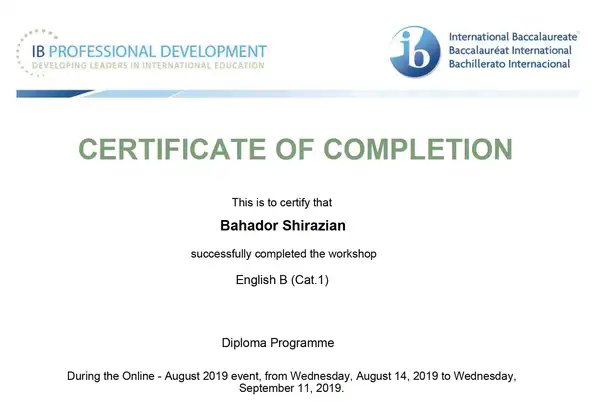
Mr. Bahador Shirazian (Mr. B) is a certified IBDP teacher and active IB examiner with over 15 years of experience teaching IB Theory of Knowledge, IB English A, and IB English B.
He is the author of a bestselling TOK book and has created the TOK Teacher Toolkit — a video course used by over 100 teachers monthly around the world. He holds a Bachelor's degree in Teaching and a Master's degree in Business.
All of Mr B's Extended Essay students consistently score 30 points and above. His deep understanding of the IB assessment framework gives students a significant advantage — not just in TOK, but across the entire IB Diploma.
Mr B also teaches IB English A & B — view the English page →
What Our IB Students Say
5.0 stars from verified Google reviews. See what students and parents say about Photon Academy.
Theory of Knowledge is one of the three core components of the IB Diploma Programme. It is a philosophical course that challenges students to examine the nature of knowledge itself — asking how we know what we claim to know, what counts as evidence, and how different disciplines construct and validate knowledge. Students explore Areas of Knowledge (such as the sciences, arts, mathematics, and ethics) through Ways of Knowing (such as reason, emotion, language, and sense perception).
TOK is assessed through two components: the TOK Essay (external, 1,600 words on a prescribed title chosen from six options) and the TOK Exhibition (internal, three objects linked to one of 35 IA prompts). Together with the Extended Essay, these contribute up to 3 bonus points towards the IB Diploma. TOK is graded on an A to E scale.
Yes — significantly. The combination of TOK and the Extended Essay can add up to 3 bonus points to your total IB Diploma score out of 45. A strong TOK grade can mean the difference between 40 and 43 points, which matters greatly for university admissions. Conversely, a grade E in TOK is a failing condition for the entire IB Diploma.
TOK is taught exclusively by Mr. Bahador Shirazian (Mr. B), an active IB examiner with over 15 years of experience. Mr B marks real TOK essays every exam session, is the author of a bestselling TOK book, and has created the TOK Teacher Toolkit used by over 100 teachers monthly worldwide. All his EE students consistently score 30+.
The TOK Exhibition is an internal assessment where students choose three specific, real, personal objects and link all three to one of 35 IA prompts provided by the IB. Students write commentaries (up to 950 words total) explaining how each object connects to the chosen prompt through a knowledge lens. A strong exhibition requires genuinely personal objects, clear connections to TOK concepts, and a cohesive argument across all three objects.
The TOK Essay is a 1,600-word external assessment on a prescribed title. Each year the IB releases two sets of six titles — students choose one corresponding to their graduation semester. Unlike a standard essay, the TOK essay requires arguing both for and against the title, exploring multiple perspectives across different Areas of Knowledge. Common mistakes include ignoring counter-arguments, using weak examples, and failing to connect back to the title.
A Knowledge Question is an open-ended, contestable question about the nature of knowledge — distinct from factual questions about specific subject content. For example, "How do scientists know that a theory is reliable?" is a KQ. Identifying and exploring strong KQs is at the heart of both the TOK Essay and Exhibition. Mr B teaches students a systematic method for forming and developing KQs that meet IB assessment criteria.
The IB releases TOK Essay titles twice per year — once in September for May graduates and once in February for November graduates. Students should begin discussing possible titles with their tutor as soon as they are released, as developing a strong essay takes several weeks of iteration and feedback.
Start by reading and deeply understanding the 35 IA prompts. Choose a prompt that genuinely connects to ideas you have explored in your TOK lessons. Then select three specific, real, personal objects — not abstract concepts. Write your commentaries focusing on explicit connections between your object, the prompt, and TOK concepts. Mr B guides students through every stage, from prompt selection to final submission.
The most common mistakes are: (1) writing the TOK Essay like a normal academic essay without genuine knowledge questions; (2) ignoring counter-arguments or treating them superficially; (3) using generic or second-hand examples rather than specific, personal real-world cases; (4) choosing abstract or non-specific objects for the Exhibition; and (5) leaving both assessments too late. Mr B addresses all of these from the first session.
Work with an active IB examiner who knows exactly what the marking criteria rewards. Trial classes available.
Leave your details and our team will reach out within 24 hours to discuss class availability and scheduling.
Or message us directly:
WhatsApp +65 9712 4269 →